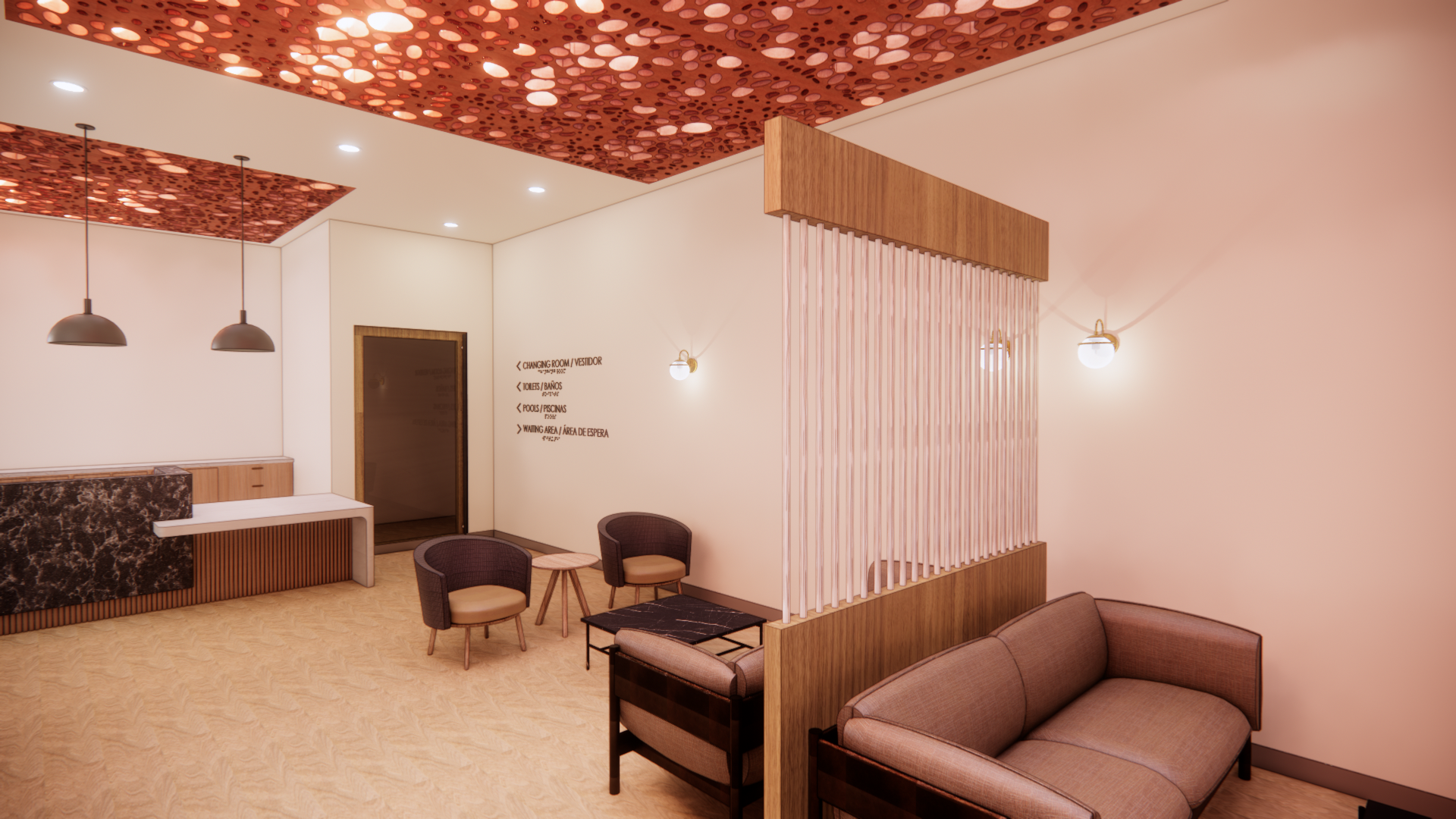
reception area of a public bathhouse perspective view from corner materials must remain strictly as follows reception desk fascia is dark veined black and white marble lower panels are vertical fluted warm walnut wood laminate with brass drawer pulls white stone countertop the freestanding partition screen is constructed of thick natural twisted jute rope strands each rope is approximately 20 25mm in diameter tightly twisted with visible fiber texture and natural tan cream coloring hanging vertically in parallel rows from a warm walnut oak header beam and anchored to a matching walnut base frame the rope has organic variation in tone some strands slightly darker some lighter with soft shadows cast between each rope strand creating depth and rhythm the partition reads as a tactile artisanal element not painted rods not wood slats not string thick twisted natural rope lounge chairs are dark charcoal woven textile upholstery with tan leather seat cushion light oak tapered legs coffee table is dark nero marquina marble sofa is dusty mauve or warm rose upholstered fabric pendant lights are matte dark charcoal dome shades on black rods brass frosted globe wall sconces on white painted walls multilingual wayfinding signage in small serif text dark wood framed interior door floor is large format rectified porcelain tile in a wood look finish each tile is approximately 1200x200mm laid in a straight staggered brick bond pattern with hairline grout joints of 2 3mm in light grey the porcelain surface has a matte to satin sheen with a subtle reflective quality distinct from real wood the wood look print on the tile shows light blonde oak grain running along the length of each tile with soft variation between tiles some slightly warmer some cooler mimicking the look of a curated wood look porcelain collection like ragno woodtale or marazzi treverkever tile edges are sharp and rectilinear grout lines are clearly readable as a grid across the floor plane the floor does not look like real timber it reads unmistakably as large format porcelain with a printed wood grain surface the perforated terracotta ceiling panel is backlit by natural daylight from above casting hundreds of soft oval and circular light projections scattered across the white walls and floor below the effect reads exactly like dappled sunlight through a perforated screen with overlapping pools of warm diffused light covering large portions of the wall surface in an organic pattern the light projections on the walls are soft edged slightly warm white and vary in size and intensity brighter near the ceiling softer further down the wall the ceiling perforations themselves glow with a warm backlit quality but do not read as harsh point sources the overall effect is atmospheric and immersive like being inside a lantern do not render this as individual defined light shafts or spotlights the light is scattered diffused and covers the walls in a wash of dappled organic shapes no orange color cast on walls projections are warm white to pale gold only interior artificial lighting from pendant domes and brass wall sconces is warm soft and low ambient incandescent quality no sharp hotspots no overblown light cones lighting feels like late afternoon indoor warmth not studio flash overall color temperature is neutral to slightly warm creamy whites natural wood tones charcoal mauve brass accents the terracotta ceiling should be a rich background element not the dominant color washing the room style is architectural collage render photorealistic material textures composited with a handcrafted editorial quality slight paper or print texture overlay analog film grain throughout visible material sample quality each surface reads as a distinct tactile material mixed media feel part architectural photography part printed mood board muted sophisticated palette medium format lens perspective slight vignette post processing and finish style heavy analog film grain throughout the entire image grain is coarse visible and consistent across all surfaces including shadows and highlights similar to pushing kodak tri x 400 or kodak portra 800 two stops in low light the image should look like it was shot on a medium format film camera scanned on a flatbed scanner and lightly retouched grain is not subtle it is a dominant visual texture layered over every surface color is slightly desaturated and muted not vivid or saturated tones are flattened slightly as if faded by age or exposure to light there is a soft vignette darkening the four corners and edges of the frame midtones are slightly lifted blacks are not fully crushed the image has a lifted shadow quality like an overexposed film print the overall image feels like an architectural photograph from a 1970s or early 1980s interiors magazine printed on slightly uncoated paper stock with a warmth and imperfection that reads as handmade and analog not digital not cgi not a clean render feels printed tactile and editorial collage quality as if individual material elements were photographed separately and composited by hand onto a background print